Neo-Narval: New Achievement in Velocimetric Performance
The first exoplanet detected orbiting a main-sequence star, 51 Peg b, was discovered in 1995 using the Elodie spectrograph at the Observatoire de Haute-Provence (OHP).
Its hot Jupiter orbit is now well-characterized, inducing a radial velocity amplitude of less than 60 m/s in the host star.
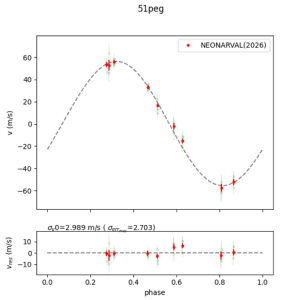
During the summer of 2026, the star was monitoredi with Neo-Narval, with each exposure obtained using a simultaneous Fabry-Pérot calibration on the third fiber. Additionally, both science fiber channels were preceded by a Fabry-Pérot exposure.
Combined with improvements to the velocimetric code, the standard error in velocity measurements is now below 3 m/s, which inspires great optimism for the velocimetric capabilities of Neo-Narval in spectropolarimetric mode.
The following plot shows the star’s reflex velocity curve, with the second part displaying the residuals. The RMS of these residuals is below 3 m/s.